
What a backtest can answer
A backtest applies defined rules to known historical data. It can show how often signals occurred, how gains and losses were distributed and how sensitive the model is to particular assumptions.
It does not prove that the same outcome could have been achieved in real time. Small differences in data source, timing, stop execution, costs or position sizing can change the result.
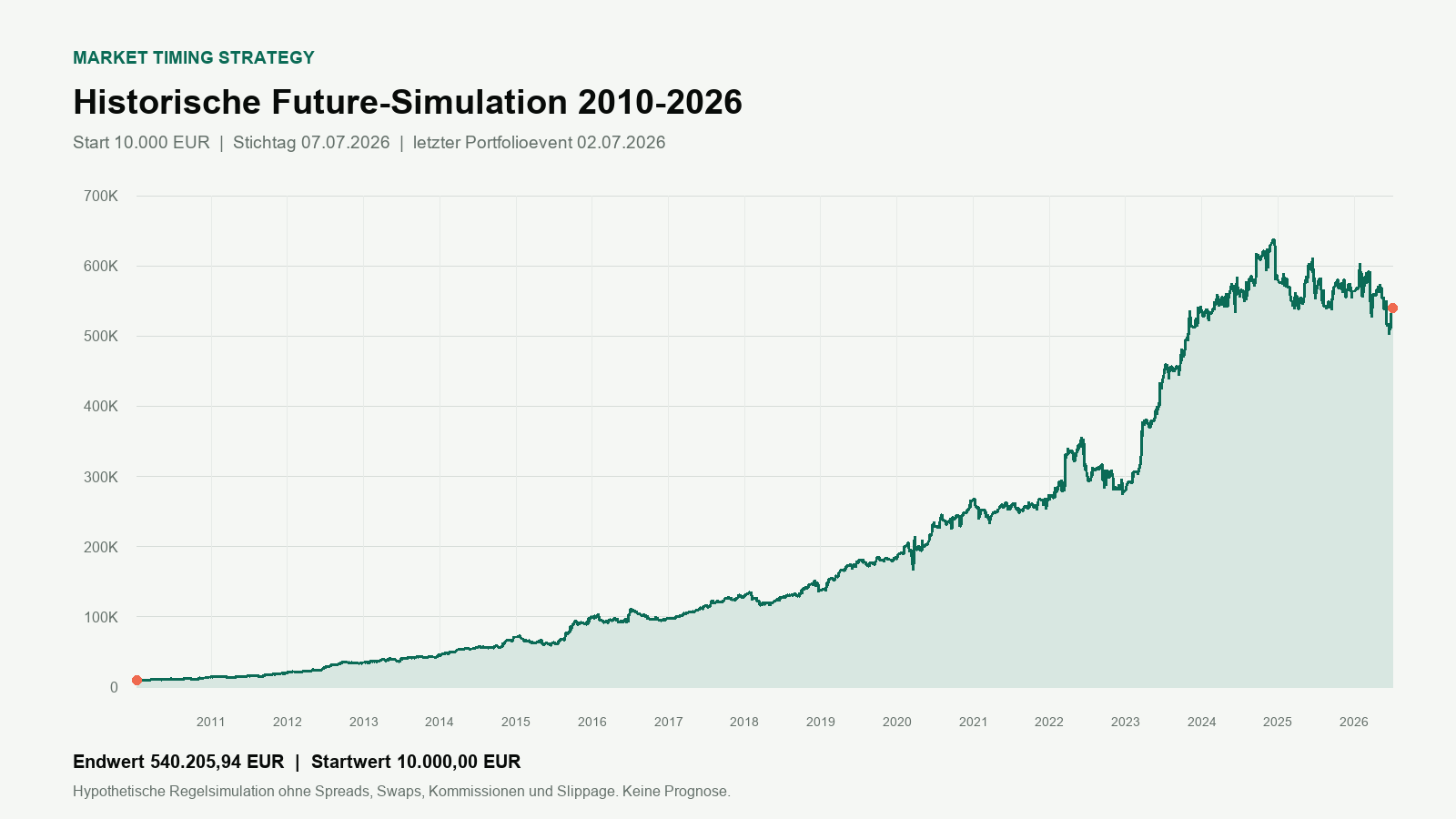
Why a gross simulation differs from a real account
A futures simulation first measures market movements. A CFD account instead trades broker-specific quotes and incurs real costs. Spreads, swaps, slippage, commissions, price gaps, rejected orders and currency conversion can reduce real performance.
Every published curve should therefore state which costs are included. The broker costs listed on the main page are not part of the historical gross simulation.
Balance, equity and drawdown
Balance changes only when a position closes. Equity also includes the current gain or loss of open positions. An event-based chart can therefore understate risk between recorded portfolio events.
The published historical curve and simulation drawdown are based on recorded portfolio events. They are not a tick-by-tick maximum-risk calculation; interim open losses may have been higher.
What a verified live account adds
A verified live account shows that orders were actually executed at a broker. It includes real costs, technical interruptions and practical differences between a rule and its execution.
A new live account nevertheless has only a short history. A few months cannot prove long-term durability or cover a complete market cycle. The live account and historical simulation are therefore displayed and linked separately.
Five questions before a purchase
A serious review starts with the assumptions rather than the largest return figure.
- Which data source and time resolution were used?
- From what date are the displayed components documented?
- Which costs and broker differences are excluded?
- How is open-position equity marked?
- Is the live account separately verified and current?
The two records serve different purposes
The historical simulation helps examine rules across different market periods. The live account shows the real implementation so far. Neither record guarantees future profit.
Reading both separately, reviewing the published notices and testing the technical environment leads to a more informed decision without confusing a projection with proof.